What Is Vicarious Resilience? A Guide for Therapists
Originally published March 18, 2023. Last updated July 2026.
Vicarious resilience is the positive transformation a therapist experiences from witnessing clients' resilience and recovery. First named by Hernández, Gangsei, and Engstrom (2007), it develops through the same empathic engagement that produces vicarious trauma: the openness that lets your clients' pain affect you is the same openness that lets their healing strengthen you.
If you came here from my guide to vicarious trauma, you already know the first half of this story: trauma work changes the person doing it, those changes have names, and every one of them is an expected part of the job. This is the second half. The empathic channel that carries your clients' pain into your nervous system carries their healing in too, and that transfer has been documented, named, and studied for nearly two decades.
If you landed here on your own, you may already know this experience without having a word for it. A client who spent months unable to leave the house takes a bus across town, and something loosens in your own chest. You catch yourself borrowing a client's courage on a hard day that has nothing to do with work. Most therapists keep these moments quiet, half-suspecting we're not supposed to feel good because of a client's trauma work. You are supposed to, it turns out, and the research on why is some of the most useful reading in our field. The concept was developed studying psychotherapists, and it has since been observed in other helping professionals who witness recovery up close, from medical providers to advocates to teachers. This guide is written for therapists, because that's who I am and who I work with, but if you do any of that work, this page is for you too.
I'm Jenny Hughes, PhD, a licensed clinical psychologist and Assistant Professor at UTHealth Houston and LSU Health Sciences Center, where I treat adults with PTSD. I wrote The Triggers to Glimmers Vicarious Resilience Workbook and Journal, and I founded The BRAVE Trauma Therapist Collective, where vicarious resilience is not a nice idea we mention in passing but the working core of how we help trauma therapists stay in this field. I've had my own run-ins with vicarious trauma, and I can tell you exactly which clients' recoveries kept me in the work when it would have been easier to leave. Vicarious resilience was doing that for me years before I had a name for it.
This guide covers where vicarious resilience comes from and who actually named it, how it relates to vicarious trauma, how it differs from post-traumatic growth and compassion satisfaction, what it feels like in the room and in your body, whether it's okay to experience it at all, and how to build it deliberately using the framework I teach: Identify, Install, Enhance. By the end you'll have language for something you've probably been experiencing for years, and a way to make it stronger on purpose.
Where does the concept of vicarious resilience come from?
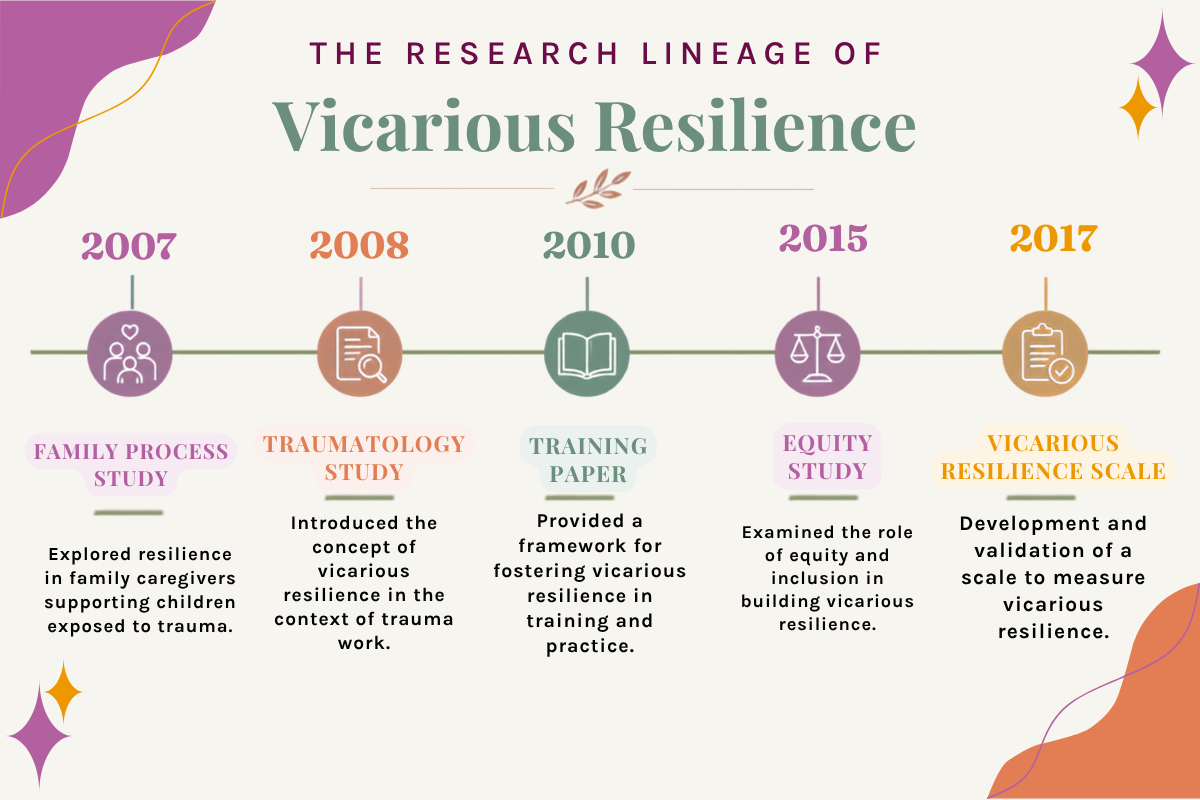
Vicarious resilience was named by Pilar Hernández, David Gangsei, and David Engstrom in a 2007 study published in Family Process. Interviewing 12 psychotherapists who worked with survivors of political violence and kidnapping, the researchers formalized something they had observed for years in clinical practice: witnessing clients overcome severe adversity was strengthening the therapists themselves.
Vicarious resilience didn't come from a wellness retreat or a positive psychology seminar. It came from some of the heaviest trauma work in the field. Hernández, Gangsei, and Engstrom were embedded in the torture survivors' movement in the United States and in clinical work amid the political violence Colombia lived through in the 1990s and 2000s. Supervising and collaborating with therapists in those settings, they kept noticing an effect the existing literature had no name for. The vicarious trauma research explained how this work wounds the people who do it, and said nothing about the ways witnessing survival was visibly sustaining them.
You'll sometimes read that the researchers stumbled onto vicarious resilience by accident while studying vicarious trauma. It's a good story, but it isn't quite what happened, and the actual history gives the concept more weight, not less. By the time the 2007 study ran, the team had already been developing the idea for years, and the study was designed from the start to formalize it. They asked their participants directly how their clients' resilience had affected them. The answers converged on themes the field now recognizes as the core of vicarious resilience, including changed perceptions of their own problems, renewed hope, a deepened sense of the work's meaning, and a reassessment of what human beings can survive.
A year later, the team extended the research to a U.S. sample of ten providers treating torture survivors (Engstrom, Hernández, & Gangsei, 2008) and found the same architecture. From there the concept grew a genuine research lineage. Hernández, who publishes as Pilar Hernández-Wolfe in her later work, went on with Kyle Killian and the original team to study how vicarious resilience and vicarious trauma coexist in the same clinicians, and how awareness of inequity shapes both (Hernández-Wolfe, Killian, Engstrom, & Gangsei, 2015). Edelkott and colleagues (2016) deepened the qualitative picture. In 2017, Killian, Hernández-Wolfe, Engstrom, and Gangsei published the Vicarious Resilience Scale, a validated measure built from the themes of those earlier studies. So when you hold this concept, hold it as what it is. Vicarious resilience is not an inspirational reframe someone invented for a keynote. It is a defined, studied, measurable construct with nearly two decades of evidence behind it, born from the most demanding trauma work there is.
Is vicarious resilience the opposite of vicarious trauma?
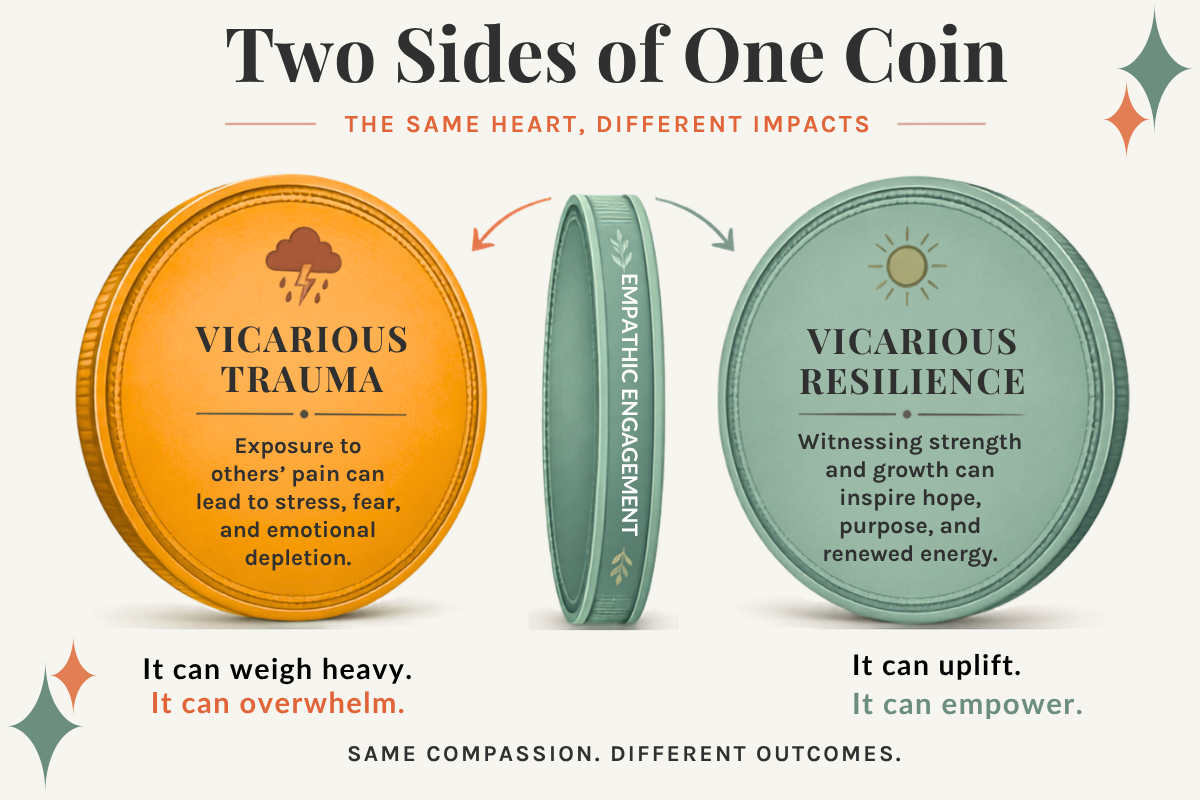
No. Vicarious resilience and vicarious trauma are not opposite ends of a single spectrum. They are two effects of the same empathic engagement, and research shows they occur in the same therapists at the same time (Hernández-Wolfe et al., 2015). The openness that exposes you to one is the openness that gives you access to the other.
This distinction changes how you carry both. If the two were opposites, experiencing vicarious trauma would mean you were failing at vicarious resilience, and building resilience would mean your trauma responses should fade on schedule. Neither is true. The 2015 research found these experiences intertwined in clinicians doing some of the heaviest trauma work there is, pain and hope arriving through the same channel, often in the same season of a career and sometimes in the same week. You can be carrying a client's images home with you and, in the next hour, feel genuinely changed by another client's first steps back into their life. Both are real, and neither cancels the other.
The channel they share is your attunement. You spend your working hours tracking another person's emotional state closely enough to respond to it, and you trained for years to do that well. A nervous system that practiced opening to other people's inner worlds doesn't get to choose what comes through. When your client relives the worst thing that ever happened to them, you feel some of it, and when that same client sits across from you visibly stronger than the person who first walked in, you feel some of that too. Attunement was never a one-way door.
If you want the full picture of what comes through the door first, I've mapped that in my guide to vicarious trauma, including the Trauma Therapist Trauma Response, my model for how vicarious trauma, compassion fatigue, secondary traumatic stress, and burnout unfold in trauma therapists. This guide picks up where that one ends. Once you know the impact of the work is normal, the next question is what the same openness can build in you, and that question has better answers than most therapists have been given. The goal was never to feel less. It's to let the healing reach you as reliably as the hurt does.
Vicarious resilience vs. post-traumatic growth vs. compassion satisfaction
These three constructs describe different positive experiences. Vicarious resilience is transformation in the helper from witnessing a client's recovery. Post-traumatic growth is positive change in a trauma survivor from their own struggle with what happened to them. Compassion satisfaction is the fulfillment a helper draws from doing the work of helping well.
The trauma field is crowded with terms for what this work takes from you, and nearly as crowded with terms for what it gives. If you've used these three interchangeably, you're in good company, because parts of the literature do too. They come from different research traditions, though, and the differences matter for knowing what you're actually experiencing.
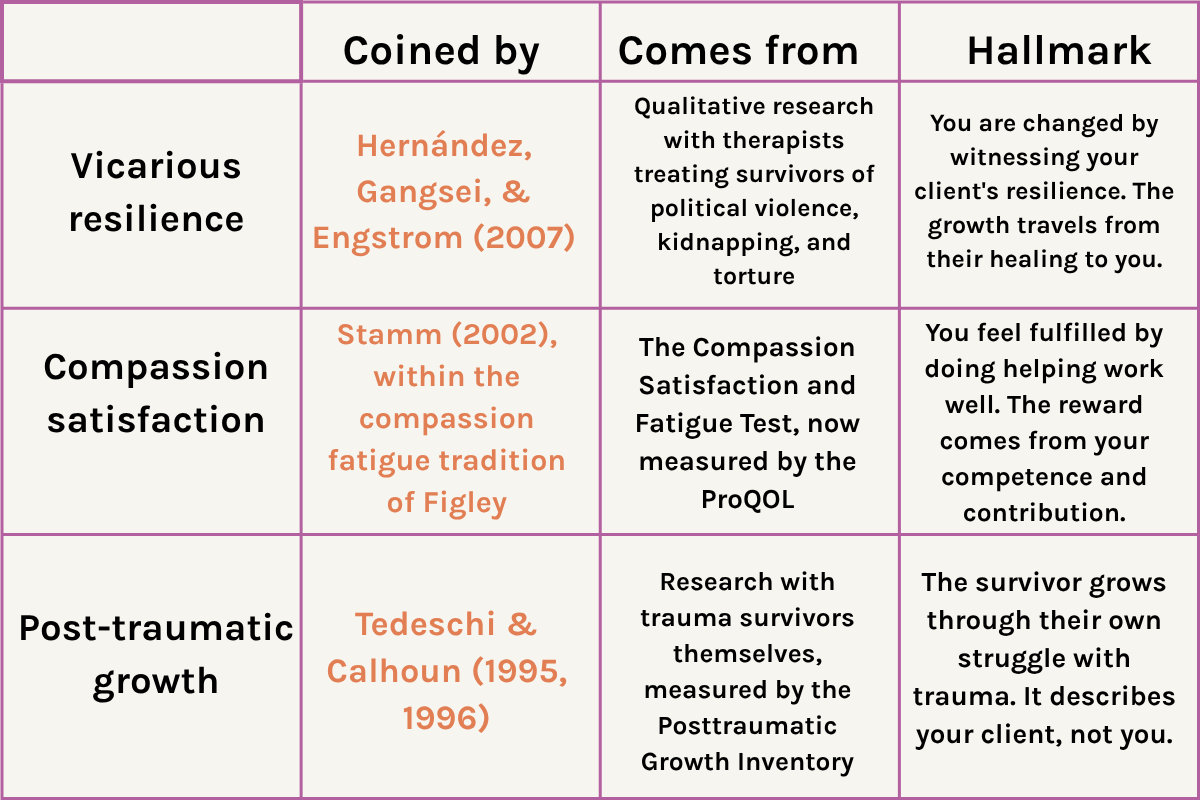
Vicarious resilience comes from witnessing healing, compassion satisfaction comes from doing the work well, and post-traumatic growth belongs to the survivor doing the healing.
The two that get mixed up most often are compassion satisfaction and vicarious resilience, because both happen in you. Compassion satisfaction is about your work. You ran a solid session, the intervention landed, and you drive home feeling like you're good at your job. Vicarious resilience is about what your client's recovery does to you. A client who couldn't say the words out loud six months ago tells her story start to finish, and something shifts in how you see people, including yourself. One comes from doing the work well, and the other comes from witnessing someone heal. It helps to know which one you're feeling, because compassion satisfaction sends you back to your craft, while vicarious resilience is something you can deliberately build. The second half of this guide shows you how.
What does vicarious resilience feel like?
Research identifies seven dimensions of vicarious resilience, including client-inspired hope, changes in life goals and perspectives, greater capacity to stay present during trauma narratives, increased self-awareness and self-care, and expanded resourcefulness (Killian et al., 2017). In practice, it feels like your clients' recoveries changing how you move through your own life.
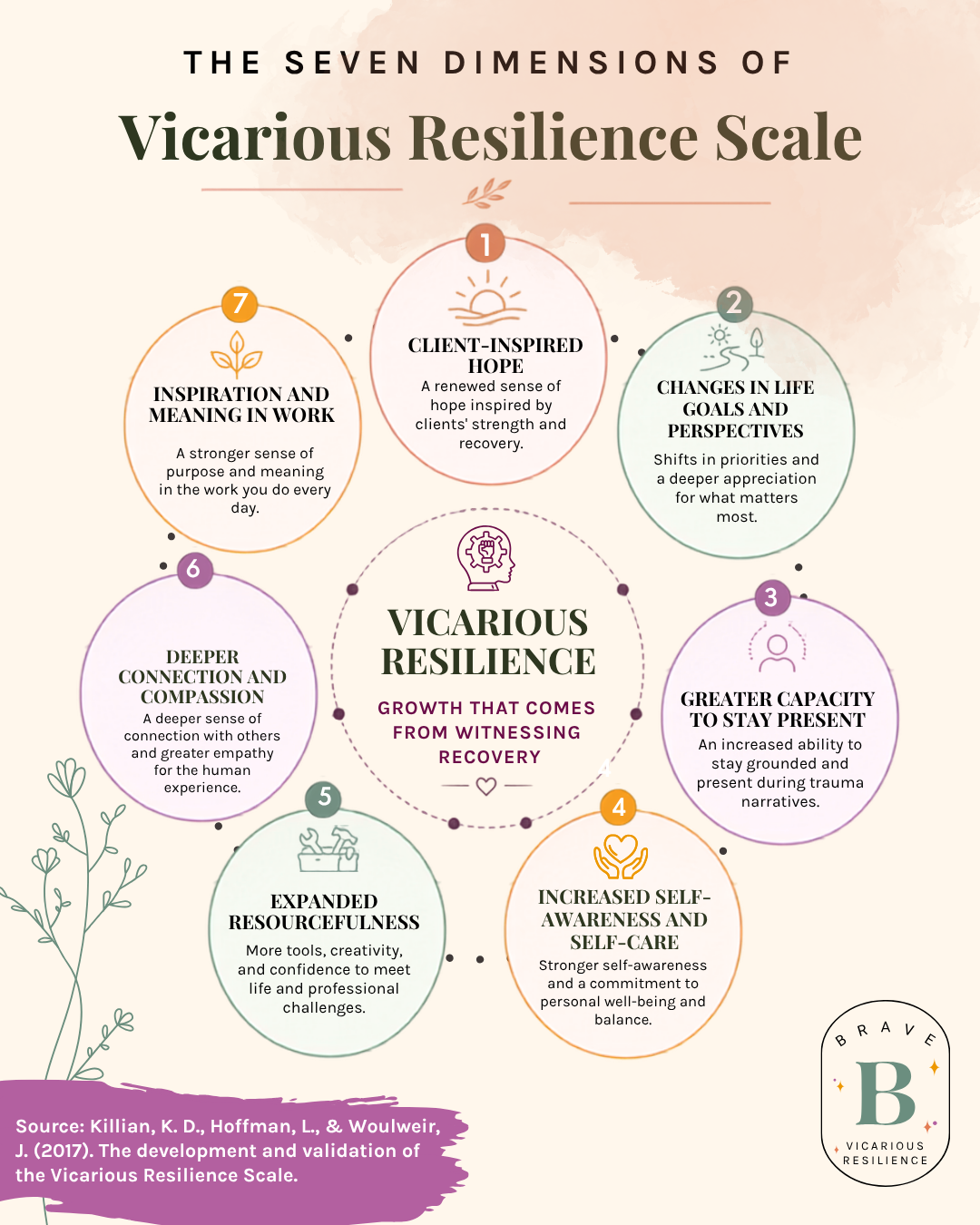
The signs below come straight from the research, drawn from the qualitative studies and the Vicarious Resilience Scale built from them. You'll notice none of them are dramatic. Vicarious resilience rarely announces itself, which is exactly why most therapists experience it for years without a name for it. Read these as a recognition exercise rather than a checklist, and notice which ones you've already lived.
Hope that outlasts the session
A client who couldn't leave her house last spring texts your practice line to reschedule because she got a job. You feel the good news in your chest, and it's still there hours later when you're with a different client whose progress has stalled. Client-inspired hope is the most consistently documented dimension of vicarious resilience, and it transfers. Hope you caught from one client shows up in the room with the next one.
Your own problems get resized
After a week of sitting with what your clients have survived, the thing that was eating at you on Monday holds less weight, not because you're minimizing your own life but because your sense of what people can move through has expanded, and you're a person. Participants in the original studies described reassessing the scale of their own difficulties against what they witnessed. When it's working, it doesn't feel like comparison. It feels like proportion.
You can stay present for the worst parts
Early in your career, certain details made you brace. Somewhere along the way, you developed the capacity to stay in the room while a client tells you the thing they've never said out loud, without leaving your own body to do it. The research names this increased capacity to remain present during trauma narratives, and it grows partly from having watched people survive the telling. You've seen where the story goes after the worst chapter, and that knowledge steadies you inside it.
You take your own nervous system seriously
You've watched grounding work for your clients often enough that you started using it yourself in traffic. You notice your own early warning signs sooner than you used to, because you've spent thousands of hours learning what dysregulation looks like from the outside. Increased self-awareness and self-care practices are a documented dimension of vicarious resilience, and this one runs on borrowed evidence. Your clients keep proving the tools work.
You borrow your clients' resourcefulness
A client rebuilds her life with almost nothing, and six months later, facing your own hard season, you catch yourself thinking about how she did it. The researchers call this increased capacity for resourcefulness. Therapists in the original studies described their clients' creative survival as a kind of instruction they didn't know they were receiving.
The work reorders what matters
Therapists in these studies described a widened frame, including a deepened respect for the role of clients' spirituality and meaning-making in healing, and a sharpened awareness of power, privilege, and what their clients are up against outside the therapy room. You may not use those words. You might just notice that you see your community differently than you did five years ago, and that the way you vote, spend, and show up has shifted because of what your clients have taught you.
If several of these landed, you're in good company. You've been building vicarious resilience the whole time you thought the work was only costing you something.
Is it okay to feel good because of my clients' trauma work?
Yes. Feeling strengthened by witnessing your clients' recovery is a documented, expected effect of trauma work, not a boundary violation or a sign of self-interest. The researchers who named vicarious resilience recommended that therapists deliberately attend to and cultivate it, and later research found it coexists with serious ethical awareness (Hernández-Wolfe et al., 2015).

Most therapists have a version of this question and almost nobody asks it out loud. You leave a session where a client described the worst thing that ever happened to them, and part of what you're feeling is moved, hopeful, even grateful. Then a second feeling arrives on top of the first one, something like guilt, and you file the whole experience away as slightly suspect. Inside The BRAVE Trauma Therapist Collective, when one member finally names this, the response is never judgment. It's relief, because everyone in the room has the same file.
The research is unambiguous that this experience belongs to the work. Hernández, Gangsei, and Engstrom didn't describe vicarious resilience as an occasional perk to be enjoyed discreetly. They argued therapists should notice it on purpose, because attending to it sustains the people doing the field's hardest work. Their participants, treating survivors of political violence and torture, felt it during the heaviest clinical material there is. One of the 2008 study's findings was that witnessing client resilience helped "recharge the batteries" of therapists doing that work. If it was legitimate there, it is legitimate in your office.
The ethics question deserves a real answer rather than a wave. What you're drawing strength from is your client's healing, not their suffering. The suffering was never yours to use, and vicarious resilience doesn't touch it. It comes from the other half of what you witness, the half your training taught you to watch for anyway. The 2015 research adds something important here. The same clinicians experiencing vicarious resilience also carried a sharpened awareness of power, privilege, and inequity in their clients' lives. Benefiting from the work and holding its ethics carefully turned out to live in the same therapists. One did not crowd out the other.
There's also a clinical case for letting this in. Therapy is a relationship, and your clients read you the way you read them. A therapist who genuinely registers their progress, who is visibly affected by their courage, offers something a neutral witness cannot. The energy you'd spend keeping their healing at arm's length is energy the work needs elsewhere. Letting your clients' recovery reach you isn't something the work permits. It's something the work requires.
How do you build vicarious resilience? The Identify → Install → Enhance framework
Vicarious resilience can be deliberately cultivated. The researchers who named it recommended that therapists intentionally attend to it rather than wait for it to happen (Hernández et al., 2007), and it has since been incorporated into clinical training (Hernández-Wolfe, Engstrom, & Gangsei, 2010). I teach a three-step framework for doing this: Identify, Install, Enhance.
You already have the raw material. If the signs above landed at all, you've experienced vicarious resilience, probably many times, which means the skill you're building isn't generating something new. It's catching something that already happens and making it stronger on purpose. That's a much shorter distance to travel, and it's the same skill you use clinically every day when you catch a client's strength in passing and hand it back to them with a name on it.
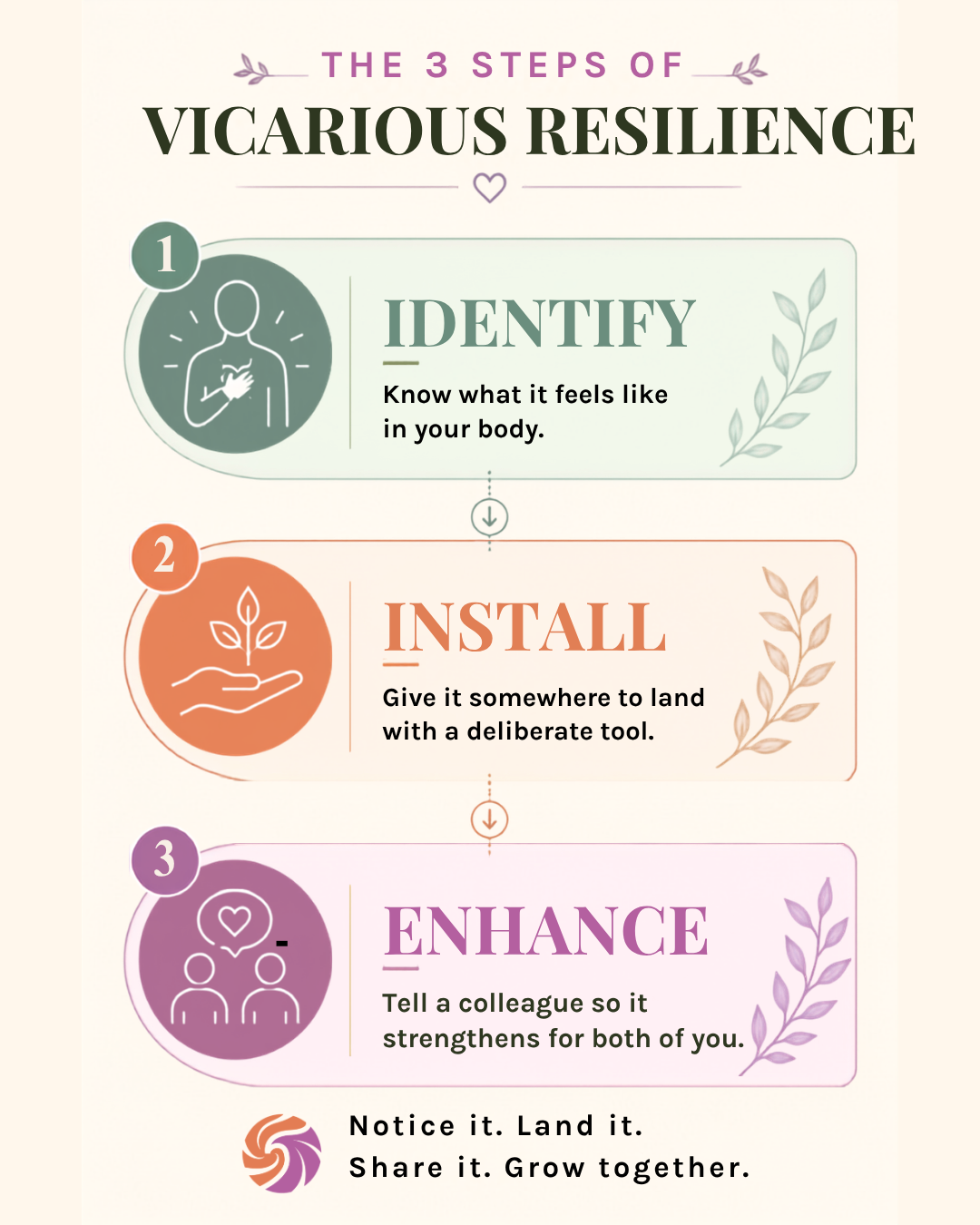
The deliberateness matters because of an asymmetry you know from the negativity bias literature and from your own life. The hard moments of this work register automatically. The client's worst detail follows you to the parking lot without any effort on your part. The good moments, the recovery moments, tend to pass through unless something catches them. Left alone, your nervous system keeps a complete record of the costs of this work and a spotty one of what it gives back. The framework exists to fix the record.
Identify
You can't strengthen what you don't notice, so the first step is knowing what vicarious resilience feels like in your body when it's happening. For some therapists it's warmth in the chest when a client comes back different. For others it's the specific species of tired-but-full that follows a hard session that went somewhere. You already know your dysregulation signature, because your training drilled it into you. This is the same skill pointed at the other half of your experience. For one week, notice the moments the work gives you something, and mark them, even if all you do is think "that one counts."
Install
Noticing opens the window, and installation is what you do while it's open. This is the step where a tool helps, because the window is short. My free Soft Transitions tool was built for exactly this, a between-sessions practice that takes under two minutes and gives the moment you identified somewhere to land. If you want structure for the full practice, the Vicarious Resilience Tracker walks you through it. It's free, it takes minutes a week, and therapists in The BRAVE Trauma Therapist Collective use it as the backbone of this work.
Enhance
Vicarious resilience gets stronger when you say it out loud to another therapist. Telling a colleague about the moment a client's recovery reached you does two things at once. The retelling deepens the installation for you, and the story lands in the other therapist's nervous system as evidence about the work itself, which means your vicarious resilience becomes a small dose of theirs. This is also the step most therapists skip, because it requires another therapist who gets it, and professional isolation is the defining condition of this career for so many of us. The framework's last step doesn't work alone, by design. Neither does the career.
Why vicarious resilience is how you stay in the work
Vicarious resilience is a career sustainability practice, not a wellness add-on. The researchers who named it framed it explicitly as a resource for sustaining and empowering trauma therapists (Hernández et al., 2007). Building it deliberately, alongside honest attention to vicarious trauma, is what makes decades in this field possible.
Most conversations about lasting in this career start from the wrong end. They start with the costs, then hand you strategies for offsetting them, as if a trauma therapy career were a debt you manage skillfully until retirement. The vicarious resilience research inverts that. From the first study, the concept was framed as what sustains the people doing this work, not what compensates them for it. You don't stay in this field for twenty years by successfully enduring it. You stay because the work is also feeding you, and because you've built the capacity to receive what it feeds you.
That capacity is only partly individual, and this is where I'll be straight with you about what the framework can and can't do alone. Identify and Install are yours. You can practice both this week without anyone's permission. Enhance requires other therapists, and not just any other therapists but ones who understand why a client's recovery would reach you in the first place. If you're in a rural area, in private practice, or the only trauma clinician in your agency, that person may not exist within fifty miles of you. This is the isolation problem, and no amount of individual practice solves a structural condition.
It's the reason I built The BRAVE Trauma Therapist Collective. It's a community of trauma therapists built around consultation calls, guest expert trainings, and the kind of peer connection where Enhance stops being a step you skip. When a member shares the moment a client's recovery got through to her, that story does for thirty therapists what this guide's last section described happening between two. If the work has been costing you more than it's been giving back, that's usually a sign the receiving structures are missing, not that you're done. The structures can be built. Come build them with us.
If you lead a team of trauma therapists, the same logic scales. The conditions that let vicarious resilience compound are trainable at the organizational level, and a team that knows how to identify, install, and enhance it together is a team you keep. The BRAVE Method brings this framework to group practices, agencies, and organizations as structured training. If sustaining your clinicians is part of your job, start there.
Vicarious resilience was born from researchers watching therapists do the heaviest work there is and noticing what kept them whole. Nearly two decades of research later, the finding holds. The therapists who last are not the ones the work never touched. They're the ones who let it touch them in both directions.
Frequently asked questions about vicarious resilience
Can you experience vicarious trauma and vicarious resilience at the same time?
Yes, and most trauma therapists do. Research with clinicians treating survivors of torture and political violence found vicarious resilience and vicarious trauma intertwined in the same therapists, often in the same season of work (Hernández-Wolfe et al., 2015). They are not opposite ends of a spectrum where one cancels the other. Both travel through the same empathic engagement, so a week where a client's story follows you home can also be the week another client's recovery changes what you believe people can survive. Experiencing vicarious trauma doesn't mean you're failing at resilience.
Is vicarious resilience just toxic positivity about trauma work?
No. Toxic positivity denies the costs of trauma work; vicarious resilience was documented alongside those costs, in the same studies, by researchers who took vicarious trauma seriously. The concept emerged from clinicians doing some of the heaviest work in the field, not from anyone minimizing it. The research consistently describes both effects coexisting rather than the positive replacing the negative. Naming what the work gives you is only toxic if it's used to dismiss what the work takes. Held together, the two halves are just an accurate account of the job.
What's the difference between vicarious resilience and vicarious post-traumatic growth?
They come from different traditions and different mechanisms. Vicarious post-traumatic growth applies Tedeschi and Calhoun's growth framework to clinicians, describing positive change that emerges from your own struggle with the impact of trauma exposure (Arnold, Calhoun, Tedeschi, & Cann, 2005). Vicarious resilience comes from witnessing your clients' resilience and recovery directly (Hernández et al., 2007). Put simply, vicarious post-traumatic growth grows out of your wrestling with the work's costs, while vicarious resilience arrives through your clients' healing. The two are related, and the Vicarious Resilience Scale correlates moderately with the Posttraumatic Growth Inventory.
Can vicarious resilience be measured?
Yes. The Vicarious Resilience Scale (VRS) is a validated 27-item measure developed by Killian, Hernández-Wolfe, Engstrom, and Gangsei (2017), built from the qualitative studies that defined the concept. It measures seven dimensions, including client-inspired hope, changes in life goals and perspectives, increased self-awareness and self-care practices, and greater capacity to remain present during trauma narratives. A confirmatory study with over 900 victim service providers in Canada later supported the same seven-factor structure. If you want a low-lift way to track your own patterns week to week, my free Vicarious Resilience Tracker was built for exactly that.
Does vicarious resilience prevent burnout?
It's protective, not preventive. Vicarious resilience gives the work a way to feed you, which offsets one major pathway to burnout, but burnout in trauma therapists is also structural, driven by caseloads, isolation, and workplace conditions no individual practice can fix. Treating vicarious resilience as burnout-proofing sets you up to blame yourself when the structural pieces give way. Build it because it makes the work sustainable and meaningful, and address the conditions around you as their own project. I've written more about that distinction in my post on what's beyond burnout.
The therapy room is the one place I feel strong, even when my own life is falling apart. Is that vicarious resilience?
It might be, and it might be compassion satisfaction, which is the fulfillment that comes from doing helping work well. The diagnostic is where the strength comes from. If the room steadies you because you're skilled there, that's compassion satisfaction. If witnessing your clients survive the unsurvivable has changed what you believe you can get through, including your own hard season, that's vicarious resilience. Members of The BRAVE Trauma Therapist Collective describe this experience constantly, and it's usually both at once. I filed it under vicarious resilience for years myself, until I sat with the definitions.
Do professionals other than therapists experience vicarious resilience?
Yes. The concept was developed with psychotherapists, but research has documented it in torture treatment providers, victim service providers, teachers, and community leaders working with survivors of severe adversity. The Vicarious Resilience Scale was validated with helping professionals well beyond therapy, including a national Canadian sample of victim service providers across diverse sectors. If your work involves witnessing people recover from serious harm up close, whether you're a nurse, an advocate, a first responder, or a case manager, the same mechanism is available to you, and the practices in this guide apply.
About the author

Jenny Hughes, PhD, is a licensed clinical psychologist and Assistant Professor at UTHealth Houston and LSU Health Sciences Center, where she provides clinical care for adults with PTSD. She is the author of The PTSD Recovery Workbook and The Triggers to Glimmers Vicarious Resilience Workbook and Journal, and the founder of The BRAVE Trauma Therapist Collective, where trauma therapists access consultation, education, and community so they can be human, build resilience, and stay in the work they love.
References
Arnold, D., Calhoun, L. G., Tedeschi, R., & Cann, A. (2005). Vicarious posttraumatic growth in psychotherapy. Journal of Humanistic Psychology, 45(2), 239–263. https://doi.org/10.1177/0022167805274729
Edelkott, N., Engstrom, D. W., Hernandez-Wolfe, P., & Gangsei, D. (2016). Vicarious resilience: Complexities and variations. American Journal of Orthopsychiatry, 86(6), 713–724. https://doi.org/10.1037/ort0000180
Engstrom, D., Hernández, P., & Gangsei, D. (2008). Vicarious resilience: A qualitative investigation into its description. Traumatology, 14(3), 13–21. https://doi.org/10.1177/1534765608319323
Hernández, P., Gangsei, D., & Engstrom, D. (2007). Vicarious resilience: A new concept in work with those who survive trauma. Family Process, 46(2), 229–241. https://doi.org/10.1111/j.1545-5300.2007.00206.x
Hernández-Wolfe, P., Engstrom, D., & Gangsei, D. (2010). Exploring the impact of trauma on therapists: Vicarious resilience and related concepts in training. Journal of Systemic Therapies, 29(1), 67–83.
Hernández-Wolfe, P., Killian, K., Engstrom, D., & Gangsei, D. (2015). Vicarious resilience, vicarious trauma, and awareness of equity in trauma work. Journal of Humanistic Psychology, 55(2), 153–172. https://doi.org/10.1177/0022167814534322
Killian, K., Hernández-Wolfe, P., Engstrom, D., & Gangsei, D. (2017). Development of the Vicarious Resilience Scale (VRS): A measure of positive effects of working with trauma survivors. Psychological Trauma: Theory, Research, Practice, and Policy. [Volume, issue, pages, and DOI on open-items list for completion before publish]
Stamm, B. H. (2002). Measuring compassion satisfaction as well as fatigue: Developmental history of the Compassion Satisfaction and Fatigue Test. In C. R. Figley (Ed.), Treating compassion fatigue (pp. 107–119). Brunner-Routledge.
Tedeschi, R. G., & Calhoun, L. G. (1995). Trauma and transformation: Growing in the aftermath of suffering. Sage.
Tedeschi, R. G., & Calhoun, L. G. (1996). The Posttraumatic Growth Inventory: Measuring the positive legacy of trauma. Journal of Traumatic Stress, 9(3), 455–471. https://doi.org/10.1002/jts.2490090305